Luxury retail rarely sends signals in press quotes. It sends signals in square metres, capital budgets, and store rebuilds. That’s why Mall of the Emirates’ expansion plan — and the decision by top maisons to upgrade rather than simply “stay put” — is worth tracking as a business story.
What’s officially happening at Mall of the Emirates (confirmed)
In April 2025, Majid Al Futtaim announced a Dh5 billion (AED 5bn) transformation of Mall of the Emirates, marking the mall’s 20th anniversary. The plan includes:
20,000 sq m of additional retail space
About 100 new stores
AED 1.1bn already allocated to enhancements underway (wellness, culture, dining precinct, infrastructure/access upgrades)
The programme is described as multi-year and phased, with timelines in public reporting pointing to staged delivery across 2025–2027 (including a cultural hub opening in 2025, more lifestyle/entertainment in 2026, and additional dining in early 2027).
A useful context point: the mall welcomed more than 40 million visitors in 2024, according to reporting on the announcement.
The “store reinvestment” story: Louis Vuitton and Rolex
Alongside the broader expansion, there’s also a visible wave of brand reinvestment inside the existing mall.
A December 2025 release distributed via Zawya states that:
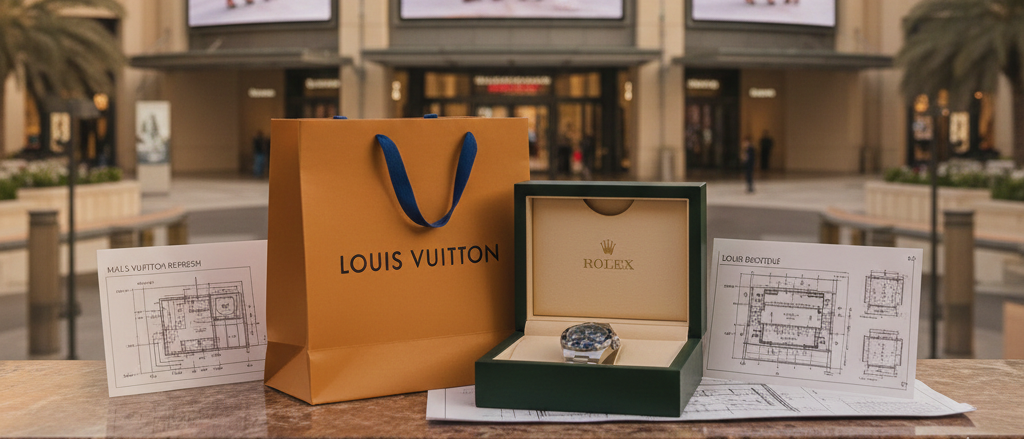
Rolex has reopened at Mall of the Emirates with a reimagined concept store
Louis Vuitton has expanded its store at the mall
Those are simple facts, but they matter because these kinds of projects typically involve fit-out spending, design upgrades, and re-merchandising — which brands generally prioritize in locations they expect to keep performing.
What “store reinvestment” can (and can’t) tell us about luxury demand
It’s important not to overclaim. A store refresh doesn’t “prove” a market is booming.
But it does give you a grounded indicator of how luxury brands are behaving:
A refreshed or expanded flagship often signals that a location is strategic enough to justify new capital spending, not just ongoing rent.
When these upgrades happen at the same time a mall operator commits to a Dh5bn capex programme, it suggests both sides are planning for a long runway of premium traffic and tenant performance.
That’s as far as we can go without speculating on sales figures or rent terms (which are not publicly disclosed in the sources above).
What the expansion actually adds (beyond “more stores”)
The official plan isn’t only retail capacity. Majid Al Futtaim’s announcement and subsequent reporting describe new and upgraded components that change how the asset earns time and spend:
A cultural hub concept (including a 600-seat theatre)
A new indoor–outdoor dining precinct, with an outdoor F&B courtyard targeted for early 2027
New entertainment additions by late 2026, including a new IMAX experience at VOX Cinemas (as described in the press release)
A practical “watchlist” for the next 12–18 months
If you’re covering this as Middle East luxury business news, these are the fact-based checkpoints worth following as they become public:
Phasing milestones (2025 → 2027)
Watch for openings tied to the cultural hub, entertainment rollouts, and the dining precinct timeline.Which categories fill the ~100 new units
The headline number is “100 stores,” but the real story is mix: luxury fashion, watches & jewellery, beauty, and experiential concepts.More “reopens” from top brands
After Rolex reopening and Louis Vuitton expanding (as reported), additional flagship reinvestments would reinforce the pattern.Footfall and access upgrades
With visitor traffic already reported above 40 million in 2024, any future updates to access infrastructure and flows are material to luxury conversion.
Mall of the Emirates’ expansion is a clear, quantified capex story: Dh5bn, 20,000 sq m, ~100 new stores, delivered in phases through 2025–2027.
What makes it especially relevant for luxury coverage is the parallel wave of store reinvestment — including Rolex reopening and Louis Vuitton expanding — because upgrades like these are one of the clearest real-world signals that brands still treat this location as strategically important.